






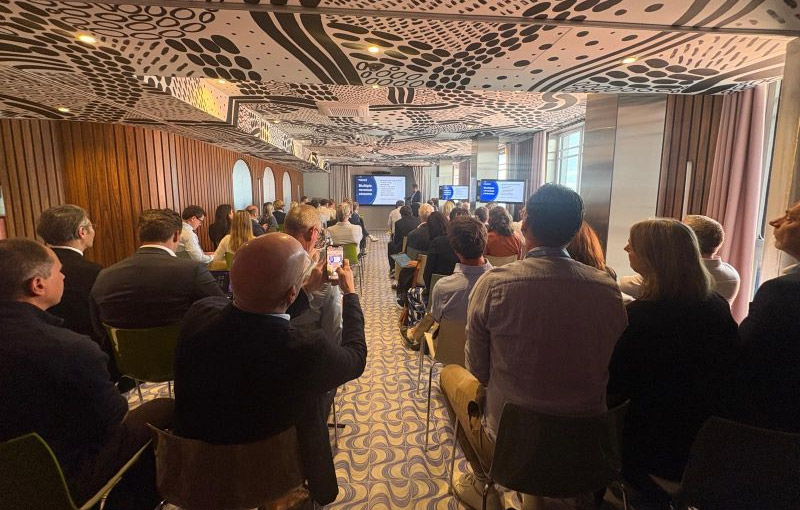
The recent Franchise Pool International forum in Lisbon was one of those events which really sticks with you. Sitting in a room full of some of the sharpest minds in global franchising – practitioners, consultants, association leaders and developers from across the world, I was reminded yet again why this industry rewards those who keep learning, keep connecting and keep asking the right questions.We’ve been giving the changing nature of international franchising a great deal of though over the last year or so, particularly in light of renewed global conflicts. Maybe things won’t ever quite be the same again, but one of the biggest lessons we’ve learnt from our global network is that international franchising definitely isn’t stopping – it’s just being forced to evolve. The forum really brought this home for us.
For those unable to attend, here is a summary of the most important things I took away from the event:
Food & Beverage still leads the pack, but the rules have changed
The F&B sector has always dominated franchising globally, and that’s not going to change any time soon. However, they’re having to work a lot harder to define their USPs, and to demonstrate they have the kind of brand traction which can separate them from the competition in a very crowded marketplace. Dark kitchens and delivery-only concepts are providing a compelling answer to the challenges of increased costs and risk, with lower overheads and fast scalability across borders.
Health and Wellness franchises are booming
Fitness studios, physiotherapy, aesthetic treatments, mental health services and holistic well-being brands are rapidly becoming the rising stars of the European franchising scene as they enter highly receptive markets and are proving especially successful at finding highly motivated franchisees. European consumers are spending more on their health and sense of self than ever before, and the unit economics in this sector are increasingly attractive. Definitely the sector to watch in 2026 and beyond!
Potential franchisees are becoming a lot more discerning
Those looking for the right franchise to invest in – both at the single-unit level, and among high-net worth investors – are better informed, better resourced and more demanding than ever before, and competition to attract the best operators is intense.
The lesson franchisors and experts in Lisbon emphasised time and time again was how thorough market entry studies and proper pre-launch research are no longer optional extras, they’re expected. Understanding your consumer, your competition, your regulatory environment and your ideal franchisee profile before committing to a market has never been more important – not just in terms of preparing yourself for every eventuality, but also for proving your worth to future investors.
Area Developer models are increasingly popular
For many years, international franchisors have largely favoured finding a single master franchise holder for an entire country, but that approach is proving increasingly outdated. Treating entire European nations as single, homogenous markets simply doesn’t work any more for a large number of modern brands. Growing populations, and regional differences in culture, language, consumer behaviour and commercial reality, mean sub-dividing territories is far more practical and tends to yield much better outcomes.
Which is why we are seeing many experienced international franchisors actively seeking Area Developers, instead, as well as asking new partners to prove the concept through their own expansion efforts first before earning the right to sub-franchise. It is a more disciplined approach, which offers advantages to both parties in terms of reducing risk and setting our a road map for sustainable growth.
The sheer scale of diversity and opportunity
Europe alone is home to 44 countries with a combined population of 748 million people. The 27 EU member states represent a market of 450 million consumers, supported by 14,900 active franchise systems generating an estimated €300 billion in annual turnover. Beyond Europe’s established markets, emerging economies – both within the continent and further afield – are presenting some of the most exciting opportunities in international franchising right now. These markets are embracing systemised operations, transferable know-how and established supply chains with genuine enthusiasm. They are agile, flexible and hungry for knowledge in a way that more saturated markets simply are not.
The United Kingdom remains one of the most compelling illustrations of what franchising can achieve in a mature, well-structured market. Contributing £19.1 billion to the national economy, with over 1,009 franchise systems operating more than 50,000 units, 90% of UK franchisees report profitability against a failure rate of just 0.5%. A dense and diverse population, strong legal frameworks, enforceable franchise agreements and a well-established British Franchise Association all underpin that performance. Growth is currently clustering around personal services, niche food and beverage, home-based working solutions and female-owned businesses. Trends that mirror what is emerging right across Europe.
What the UK example also illustrates, however, is that performance at this level is only achievable through careful preparation, local knowledge and disciplined execution, and that lesson applies everywhere. The striking variation in costs and commercial reality across European markets is a case in point. For example, the gap between operating in Lisbon and operating in London is enormous when you examine property costs, staffing, average consumer spend and realistic price points. France leads the continent with 2,089 active systems, Spain follows with 1,384, while markets like Finland (250) and Denmark (300) operate at an entirely different scale. Every one of those markets has its own dynamic, and a financial model built for one will not transplant unchanged into another. Thorough market research, honest cost modelling and genuine local insight are more important than ever.
The biggest lesson for me: real insight comes from real people
The perspectives gathered over two days of discussion and debate in Lisbon are not the kind you will find in a generic market report, and they are certainly not the kind you can generate from a handful of well-worded AI prompts. They came from franchisors, operators, advisors and market specialists who have actually entered these territories, navigated cultural differences, adapted business models, solved problems on the ground and built sustainable networks in real-world conditions.
Technology, data and AI are all proving hugely advantageous to international franchising. They are opening up levels of connectivity, research capability, communication and operational support that would have been unimaginable only a few years ago. Used properly, they can accelerate learning, improve decision-making and make global expansion far more accessible, but technology is still most powerful when combined with human experience.
So if you are exploring international franchising, speak to people who genuinely understand the markets you are considering
Talk to operators on the ground, connect with advisors who have practical experience, not just theoretical knowledge. Seek out perspectives shaped by execution, not assumption.
If you’d like to talk more about anything I’ve discussed here, please feel free to set up a time to chat. Likewise, if you’re interested in how you can make the human connections which can genuinely make a difference to your international expansion plans, let me know! I’d be happy to make some introductions.