






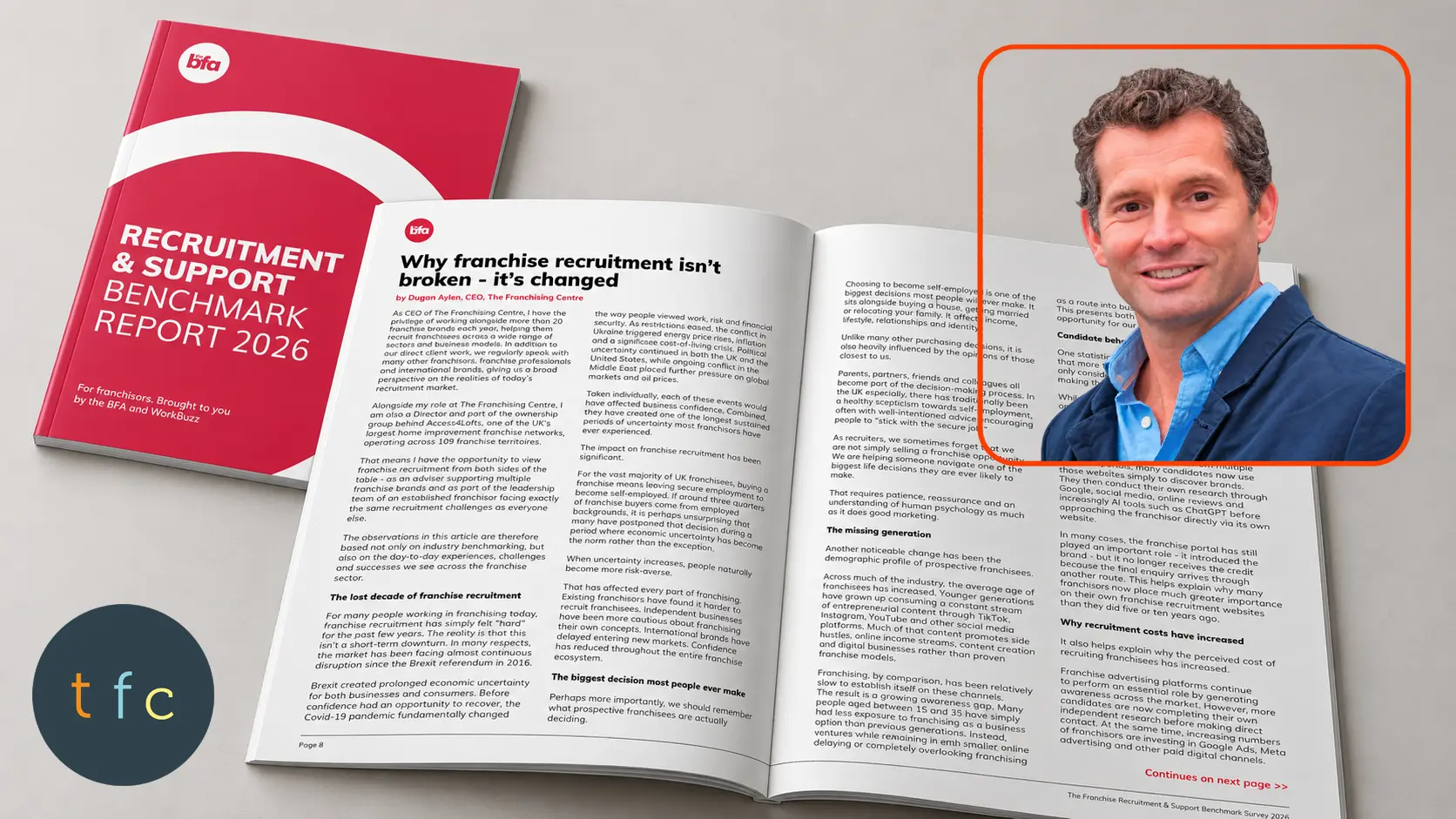
by Dugan Aylen, CEO, The Franchising Centre
As CEO of The Franchising Centre, I have the privilege of working alongside more than 20 franchise brands each year, helping them recruit franchisees across a wide range of sectors and business models. In addition to our direct client work, we regularly speak with many other franchisors, franchise professionals and international brands, giving us a broad perspective on the realities of today’s recruitment market.
Alongside my role at The Franchising Centre, I am also a Director and part of the ownership group behind Access4Lofts, one of the UK’s largest home improvement franchise networks, operating across 109 franchise territories.
That means I have the opportunity to view franchise recruitment from both sides of the table – as an adviser supporting multiple franchise brands and as part of the leadership team of an established franchisor facing exactly the same recruitment challenges as everyone else.
The observations in this article are therefore based not only on industry benchmarking, but also on the day-to-day experiences, challenges and successes we see across the franchise sector.
The lost decade of franchise recruitment
For many people working in franchising today, franchisee recruitment has simply felt “hard” for the past few years. The reality is that this isn’t a short-term downturn. In many respects, the market has been facing almost continuous disruption since the Brexit referendum in 2016.
Brexit created prolonged economic uncertainty for both businesses and consumers. Before confidence had an opportunity to recover, the Covid-19 pandemic fundamentally changed the way people viewed work, risk and financial security. As restrictions eased, the conflict in Ukraine triggered energy price rises, inflation and a significant cost-of-living crisis. Political uncertainty continued in both the UK and the United States, while ongoing conflict in the Middle East placed further pressure on global markets and oil prices.
Taken individually, each of these events would have affected business confidence. Combined, they have created one of the longest sustained periods of uncertainty most franchisors have ever experienced.
The impact on franchise recruitment has been significant.
For the vast majority of UK franchisees, buying a franchise means leaving secure employment to become self-employed. If around three quarters of franchise buyers come from employed backgrounds, it is perhaps unsurprising that many have postponed that decision during a period where economic uncertainty has become the norm rather than the exception.
When uncertainty increases, people naturally become more risk-averse.
That has affected every part of franchising. Existing franchisors have found it harder to recruit franchisees. Independent businesses have been more cautious about franchising their own concepts. International brands have delayed entering new markets. Confidence has reduced throughout the entire franchise ecosystem.
The biggest decision most people ever make
Perhaps more importantly, we should remember what prospective franchisees are actually deciding.
Choosing to become self-employed is one of the biggest decisions most people will ever make. It sits alongside buying a house, getting married or relocating your family. It affects income, lifestyle, relationships and identity.
Unlike many other purchasing decisions, it is also heavily influenced by the opinions of those closest to us.
Parents, partners, friends and colleagues all become part of the decision-making process. In the UK especially, there has traditionally been a healthy scepticism towards self-employment, often with well-intentioned advice encouraging people to “stick with the secure job.”
As recruiters, we sometimes forget that we are not simply selling a franchise opportunity. We are helping someone navigate one of the biggest life decisions they are ever likely to make.
That requires patience, reassurance and an understanding of human psychology as much as it does good marketing.
The missing generation
Another noticeable change has been the demographic profile of prospective franchisees.
Across much of the industry, the average age of franchisees has increased. Younger generations have grown up consuming a constant stream of entrepreneurial content through TikTok, Instagram, YouTube and other social media platforms. Much of that content promotes side hustles, online income streams, content creation and digital businesses rather than proven franchise models.
Franchising, by comparison, has been relatively slow to establish itself on these channels. The result is a growing awareness gap. Many people aged between 15 and 35 have simply had less exposure to franchising as a business option than previous generations. Instead, many choose to experiment with smaller online ventures while remaining in employment, delaying or completely overlooking franchising as a route into business ownership.
This presents both a challenge and an opportunity for our sector.
Candidate behaviour has changed
One statistic that often attracts attention is that more than half of franchisees reportedly only considered one franchise brand before making their investment.
While this may reflect the information captured on enquiry forms, my own experience suggests candidate behaviour has evolved considerably.
Today’s franchise buyer is more digitally confident than ever before. Rather than requesting information packs from multiple franchise portals, many candidates now use those websites simply to discover brands. They then conduct their own research through Google, social media, online reviews and increasingly AI tools such as ChatGPT before approaching the franchisor directly via its own website.
In many cases, the franchise portal has still played an important role – it introduced the brand – but it no longer receives the credit because the final enquiry arrives through another route. This helps explain why many franchisors now place much greater importance on their own franchise recruitment websites than they did five or ten years ago.
Why recruitment costs have increased
It also helps explain why the perceived cost of recruiting franchisees has increased.
Franchise advertising platforms continue to perform an essential role by generating awareness across the market. However, more candidates are now completing their own independent research before making direct contact. At the same time, increasing numbers of franchisors are investing in Google Ads, Meta advertising and other paid digital channels.
These channels often generate larger volumes of enquiries, but volume does not necessarily translate into quality. Digital advertising has become exceptionally effective at generating interest, yet much less effective at filtering genuine commitment. As a result, many recruitment teams are processing significantly more enquiries while converting a smaller percentage into franchisees.
This is why focusing solely on enquiry numbers can be misleading.
The quality of the recruitment journey—from first enquiry through qualification, education, relationship building and decision support—has arguably become more important than ever before.
Why honest benchmarking matters
Finally, it is worth recognising that surveys such as this inevitably rely on voluntary participation.
Given how challenging franchise recruitment has been over recent years, some franchisors who recruited few—or even no—franchisees during the last twelve months may understandably have been reluctant to contribute their results.
If that is the case, the picture presented here may actually be slightly more optimistic than the wider market.
That should not discourage participation.
Quite the opposite.
One of the greatest strengths of the UK franchising sector has always been its willingness to learn from one another. The more openly we share what is really happening in the market, the better equipped we become to solve the challenges collectively.
For too long, franchising has sometimes felt obliged to present only success stories. Encouragingly, that culture is beginning to change. Honest conversations around recruitment performance, marketing effectiveness and candidate behaviour allow everyone to improve.
Growing the market, not just competing within it
Looking ahead, perhaps the biggest opportunity lies beyond individual brands altogether.
Every franchisor invests in promoting their own opportunity. If the average franchisor spends around £40,000 a year on franchise recruitment marketing, collectively the UK sector is investing somewhere in the region of £12 million annually in attracting franchisees.
Imagine if every franchisor committed just 10% of that budget—not to promoting their own brand—but to promoting franchising itself as a career choice.
An industry-wide investment of more than £1 million each year could fundamentally increase public awareness of franchising, educate future business owners and expand the overall pool of prospective franchisees available to every franchisor.
Rather than competing for an increasingly limited number of candidates, we could work together to grow the market itself.
That may prove to be one of the most valuable investments the sector could make.